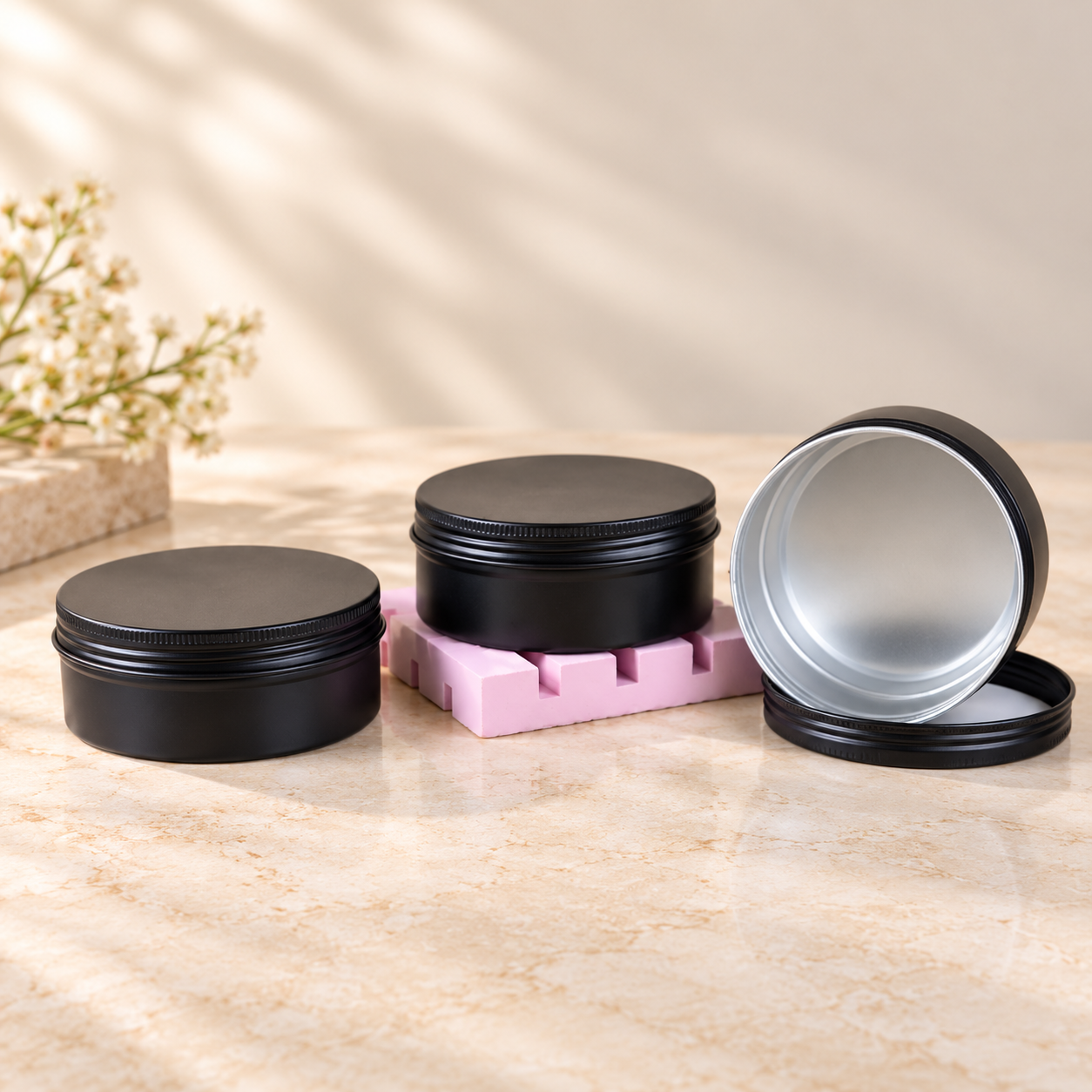
Quick Summary: Housing PHA (Gluconolactone) (pH 3.8 – 4.5, strength 4% – 8%) inside Minimalist Metal Balm Tin made of Coated Tinplate / Aluminum provides 100% Light Block and Moderate (Screw/slip lid) protection to maintain potency through the entire PAO window.
Quick Evaluation Table for Minimalist Metal Balm Tin with PHA (Gluconolactone)
| Evaluation Factor | Container / Active Spec | Practical Implication |
|---|---|---|
| Container Material | Coated Tinplate / Aluminum (Code ALU-41) | Controls chemical inertness with active base |
| UV Light Barrier | 100% Light Block | PHA (Gluconolactone) sensitivity: Low |
| Oxygen Barrier | Moderate (Screw/slip lid) | Minimizes premature oxidation and color drift |
| Optimal pH & Strength | pH 3.8 – 4.5 • 4% – 8% | Recommended AM or PM |
Stability & Usability Deep Dive
Container engineering shapes real-world performance for PHA (Gluconolactone). Designed for Anhydrous Balm & Lip Salve textures, Minimalist Metal Balm Tin reduces unnecessary air exchange and helps preserve balanced active delivery.
What to Check Before Choosing
- Cap and seal Minimalist Metal Balm Tin promptly after each measured application.
- Store between 15°C and 25°C away from sunlit windowsills and shower steam.
- Track any texture shift, off-odor, or PAO countdown printed on ALU-41 packaging.
When applying PHA (Gluconolactone) (AM or PM), avoid touching the nozzle or dropper directly to bare skin so formulas remain hygienic until the final drop.
Frequently Asked Questions (FAQ)
Is Minimalist Metal Balm Tin suitable for PHA (Gluconolactone) formulas?
Yes, when paired with compatible Anhydrous Balm & Lip Salve viscosity and 100% Light Block shielding to support pH 3.8 – 4.5 stability.
How should consumers store Minimalist Metal Balm Tin to protect PHA (Gluconolactone)?
Keep it in a shaded drawer at 15–25°C away from bathroom humidity to preserve both the Coated Tinplate / Aluminum dispenser and formula freshness.
When is the ideal time to use PHA (Gluconolactone)?
Typically AM or PM at 4% – 8% concentration, adjusted gradually according to skin tolerance.
See related guidance in Skincare Packaging & Storage Guide. Verify regulatory registration, patch test new formulas for 48 hours, and consult a dermatologist for persistent irritation.
Content is compiled for educational clarity regarding skin barrier science, active ingredients, and cosmetic packaging stability. It does not replace individualized medical advice from a board-certified dermatologist.